

Can AI Outperform Teachers in Delivering Effective Knowledge to Students
- Gabriela Aronovici

- Mar 25
- 3 min read
Education is evolving rapidly, and artificial intelligence (AI) is becoming a key player in classrooms worldwide. The question arises: can AI transmit better knowledge to a student than a teacher? This topic sparks debate among educators, students, and technologists alike. Understanding the strengths and limitations of AI compared to human teachers helps clarify whether AI can truly enhance learning or even replace traditional teaching methods.

How AI Supports Learning
AI offers personalized learning experiences by adapting to each student's pace and style. Unlike traditional classrooms where one teacher manages many students, AI can tailor lessons to individual needs. For example, platforms like Khan Academy and Duolingo use AI algorithms to identify areas where a student struggles and provide targeted exercises.
AI also provides instant feedback. When a student answers a question, AI systems can immediately explain mistakes and suggest improvements. This real-time interaction helps students correct misunderstandings quickly, which is harder to achieve in large classrooms.
Moreover, AI can analyze vast amounts of data to predict learning outcomes. By tracking progress, AI can recommend resources or adjust difficulty levels, keeping students challenged but not overwhelmed. This data-driven approach supports continuous improvement.
The Human Element in Teaching
Despite AI’s advantages, human teachers bring qualities that machines cannot replicate. Teachers understand emotional cues, motivation, and social dynamics. They inspire, encourage, and build relationships that foster a positive learning environment.
For example, a teacher noticing a student’s frustration can offer encouragement or change the teaching approach. This empathy and adaptability are crucial for student engagement and confidence. AI lacks genuine emotional intelligence and cannot replace the mentorship role teachers play.
Teachers also bring creativity and experience. They can design lessons that connect knowledge to real-world contexts, making learning meaningful. While AI can provide information, it struggles to create nuanced discussions or adapt spontaneously to classroom dynamics.
Examples of AI and Teacher Collaboration
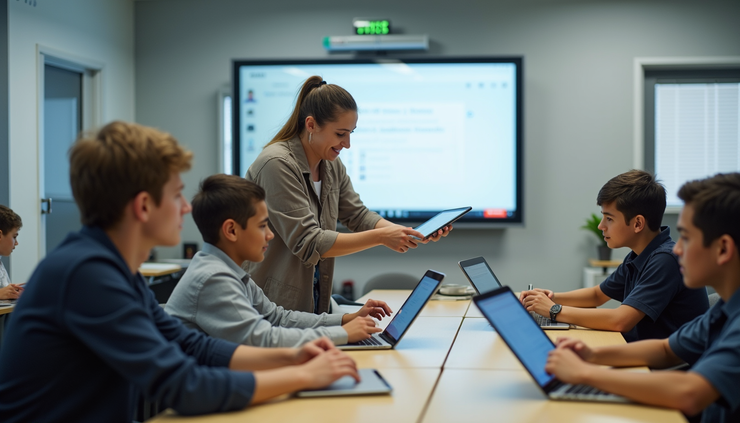
The most effective education models combine AI tools with human teachers. AI handles routine tasks like grading and personalized drills, freeing teachers to focus on complex instruction and student support.
For instance, in some schools, AI tutors assist students with math problems, while teachers lead group projects and discussions. This partnership improves efficiency and learning outcomes. Students receive personalized practice and human guidance, benefiting from the strengths of both.
Another example is language learning apps that use AI for pronunciation practice and vocabulary drills. Teachers then use class time for conversation practice and cultural lessons, which AI cannot provide.

Challenges and Limitations of AI in Education
AI faces several challenges that limit its ability to fully replace teachers. One major issue is the lack of context awareness. AI may misinterpret student responses without understanding underlying reasons or emotions.
Data privacy is another concern. AI systems require access to student information to personalize learning, raising questions about security and consent.
Additionally, AI depends on quality data and programming. Biases in algorithms can lead to unfair or ineffective teaching. For example, if AI is trained on limited datasets, it might not address diverse learning styles or cultural backgrounds.
Access to technology also varies. Not all students have reliable internet or devices, which can widen educational gaps if AI becomes the primary teaching method.
What the Future Holds
AI will continue to transform education, but it will not replace teachers entirely. Instead, AI will become a powerful tool that enhances teaching and learning.
Educators will need training to integrate AI effectively, using it to support students rather than substitute human interaction. Schools must address ethical concerns and ensure equitable access to technology.
Students will benefit most when AI and teachers work together. AI can provide personalized practice and data insights, while teachers offer guidance, motivation, and social learning experiences.



Comments